By Nick Cairns, Curator, Nonavian Vertebrates
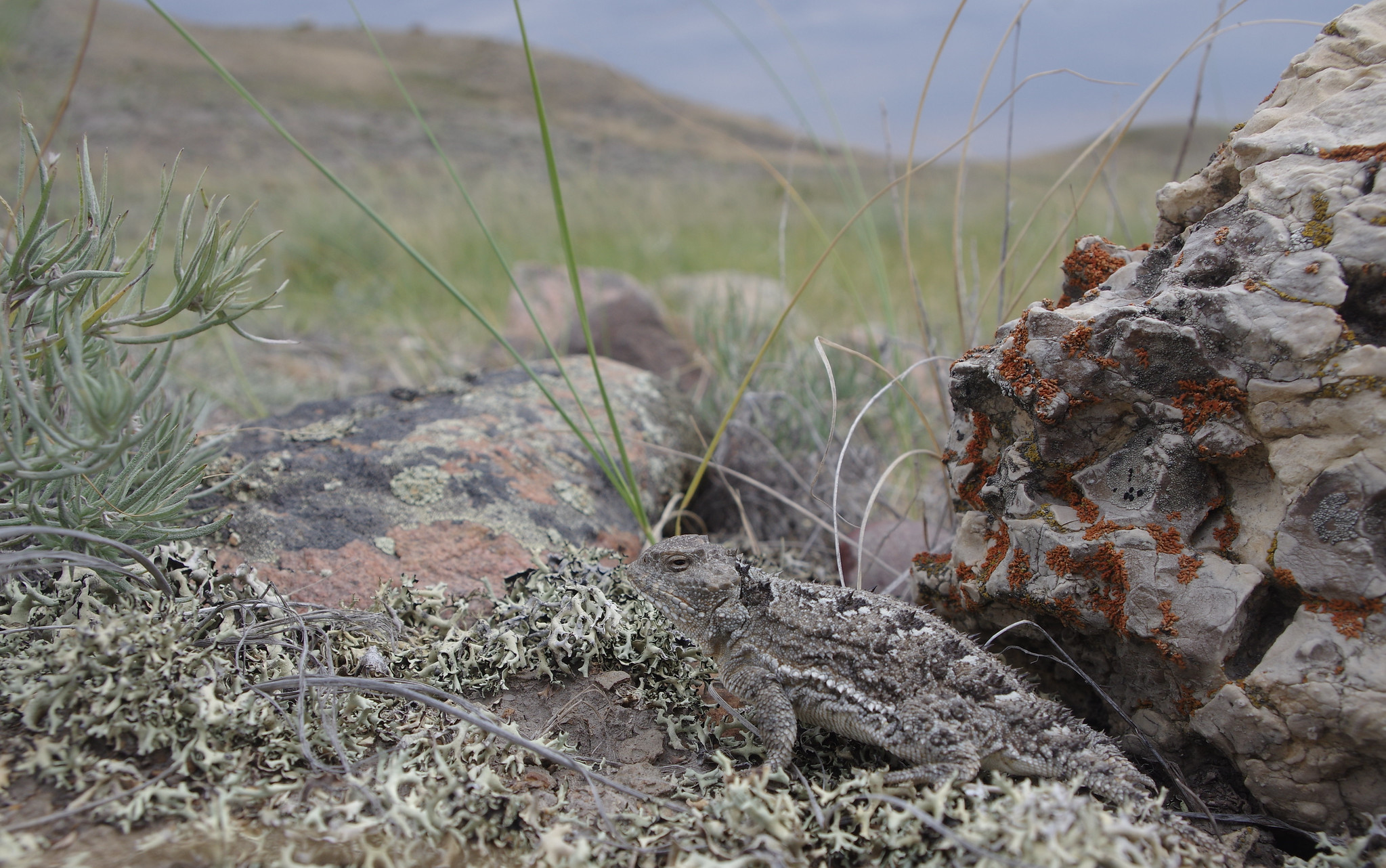
When you think of lizards, what do you think of? I’ve spent most of my life chasing lizards as a professional 7-year-old and I have always thought of them as summertime animals. I think of a small animal splayed out on the hot, dry ground, alert and watching.
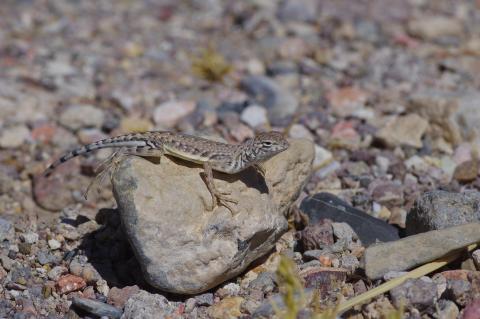
This animal moves in and out of the shade striving to keep the perfect temperature. Studying how lizards manage their summer temperatures is the way most research has been done on lizard thermal biology. This type of work has been done on Alberta’s only four-legged lizard, the greater short-horned lizard (Phrynosoma hernandesi). Doctors Larry Powell and Anthony Russell published this work in 1985 "Field thermal ecology of the eastern short-horned lizard (Phrynosoma douglassi brevirostre [hernandesi]) in southern Alberta." I love this paper and understanding its thermal biology is how you can understand how this animal spends its summer, explains how it eats, grows and breeds. The question that supersedes those population and demographic elements is how do these animals physiologically survive? We set out to try to answer that.
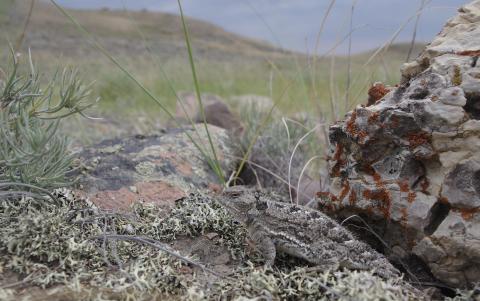
Let’s go back to what you think about with a lizard, a summertime creature but that does not match the conditions available for most of our year on the Canadian prairies. Most of our year falls well short of this species’ thermal preferences, that is because most of our season is winter and as we have discussed, lizards are summer animals. So how do they do it? Well first off, they are tough and adaptable. These lizards can be found active from late March to early November. They can function in low temperatures. Second, they go underground. This is a classic move for a reptile at high latitude. Get down deep, below the frostline where you won’t freeze. EXCEPT our horned lizards don’t do that! They only go down 7-10 cm, but the frostline exceeds a meter. Third, we do not know how they do it!
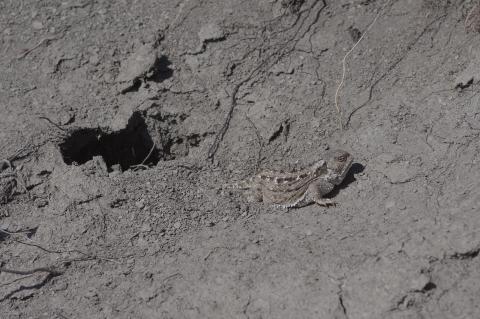
Powell and Russell noticed that the sites these lizards chose to spend the winter often appeared to collect snow. So, what might the snow be doing, and does it help them survive winter? What sort of conditions do these lizards experience? Here at the RAM, our non-avian team, with the help of an amazing team of volunteers, we have set out to explore these questions. Next post we'll talk about some of the methods we are using.
Sources
Powell, G. Lawrence, and Anthony P. Russell. "Field thermal ecology of the eastern short-horned lizard (Phrynosoma douglassi brevirostre) in southern Alberta." Canadian Journal of Zoology 63, no. 2 (1985): 228-238.