Visibility, Memory, and the Stories We Collect
By Julia Rudko, Assistant Curator, Daily Life & Leisure
In 2009, the first International Transgender Day of Visibility was recognized. Its founder, Rachel Crandall-Crocker, cited the need for a day that celebrated trans joy and stood in contrast to the more somber Trans Day of Remembrance, held each November to honour those lost to anti-trans violence. In the years since, Trans Day of Visibility has grown into a globally recognized occasion that centres the lives, achievements, and everyday experiences of trans people.
As a museum, this day offers an important moment to reflect on how stories are preserved, whose stories are shared, and whose are still missing from the historical record. Visibility is not only about how someone is seen, but how they are remembered by their communities and by institutions of memory. By collecting and sharing the stories and objects from trans Albertans, we help ensure that these lives are part of a historical record that may have previously missed, marginalized, or outright ignored their experiences.
**
Stories about the lived experiences of queer people have often been cast to the edges of, or fully omitted from, our shared history in museums and archives. A review of RAM’s existing collections showed that our representation of 2SLGBTQIA+ Albertans was limited and one dimensional. These collections were largely donated by white, cisgender, gay men to showcase their community activism in the mid-to-late 20th century. These items make up a cornerstone of Alberta’s queer history, to be sure, but tell us little about other community members or even what these individuals spent the rest of their lives doing. What about queer joy and celebration? Grief and remembrance? Gender exploration and transitions? Night life? Family life? Community? Friendships and relationships?
With these gaps in mind, the Royal Alberta Museum put out a public call for donations of items that represent queer history and experiences in Alberta, in the hopes that we can collect items that better reflect the diverse lived experiences of our queer neighbours within the collection.
**
One of the first responses to our call for donations came via voice message, offering us a 1970s book about working with women’s groups found in a local little free library. I returned the call to gather a bit more information and discerned that while the book had some fascinating content, it ultimately had no ties to Alberta beyond its present location. In conversation, though, I learned this potential donor was Harper-Hugo Darling (they/them), a Métis queer historian, author, and podcaster in the Edmonton area with roots running through southern Alberta. Harper-Hugo mentioned that they’d spent time in Lethbridge and Fort Macleod in their youth (the latter being where they’d formed a Gay-Straight Alliance at their high school), volunteered at the Edmonton Pride Centre’s Trans Camp, and were in possession of a zine about pregnancy for trans people that had been published here in Alberta.
**
I met Harper-Hugo at the museum on a sunny Monday afternoon. Harper-Hugo had agreed in advance to a recorded interview to accompany their donation. Tucked away in a quiet corner, we worked our way through the items they’d brought while a digital recorder sat just off to the side.

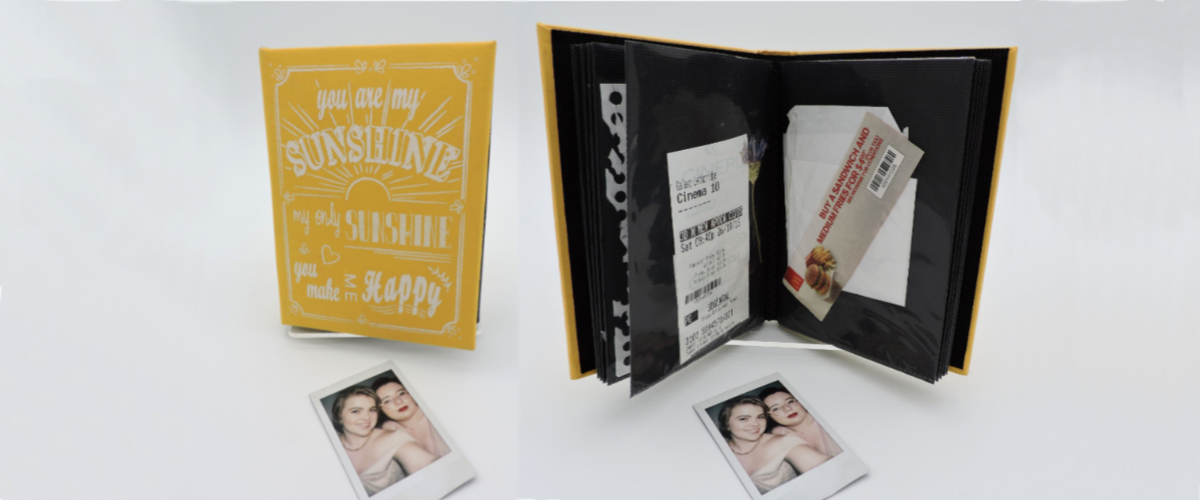
We started off talking about a paper cup from Lethbridge’s Bread Milk & Honey Café, a queer-owned business where Harper-Hugo and their now-wife, Will, went on their first date. Will had flown from Norway to meet Harper-Hugo, although they mentioned with a smile that the two had agreed to become engaged over the phone nearly six months before that first date. Other artifacts from their relationship included a scrapbook of that first visit, crammed with love notes and dried flowers, and a polaroid of the pair on their wedding day; Harper-Hugo and I agreed that we would document these two items for our records, then return them to the pair as they were still precious pieces of their lives.
Harper-Hugo also brought us items related to their activism and community work that spanned the province’s central and southern regions. Here, we were able to speak more deeply about their involvement with the Edmonton Pride Centre’s Trans Camp, where Harper-Hugo and their wife had been both attended and volunteered at different times. They showed me envelopes of thank you notes (they described these as “little Valentines”) from other attendees addressed to Harper-Hugo and Will. It was immediately clear that their mentorship meant a lot to these other campers, and that the opportunity to attend Trans Camp in a positive, affirming setting with peers was often transformational for these youth.
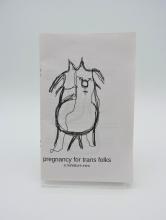
One of the most interesting pieces was one of the most understated. Harper-Hugo showed me a folded black-and-white booklet adorned with a line drawing of a human torso. This was the zine about navigating pregnancy for trans folks that they’d mentioned over the phone. The research, writing, and illustrations were done by their wife in 2017 and put together as a resource for a local youth organization. I have yet to come across another zine of this nature from Alberta in my research and am deeply appreciative of its presence in our collection as a testament to the community-led resourcefulness that so often sustains queer and trans life. It speaks to a need met not by large institutions but by individuals creating something practical and compassionate for their neighbours to ensure that others navigating similar life experiences would not have to do so alone.
After we’d worked through the objects they’d brought to donate, ended the recording, and finalized all the donation paperwork, Harper-Hugo and I continued to chat. Harper-Hugo is warm and easy to talk to, and they shared an anecdote I found particularly meaningful. Harper-Hugo told me about phone calls they’ve received from transgender youth over the years who found themselves distressed at the state of the world, and how trans people are so often persecuted for simply wanting to live as themselves. They told me that they like to recount the idea of the “happy queer peasant” to these people—the theory that, for so much of this vast timeline of human history, queerness was an accepted and uninterrogated part of community life. For all the stories we have of the oppression and victimization of 2SLGBTQIA+ people, they believe there are hundreds more of average queer people living out their normal, happy, unscrutinized lives that went unwritten in the historical record. Within the context of our work together to bring this donation of queer and trans material culture into the museum, I thought that was particularly profound. After all, isn’t getting all that queer joy into the historical record exactly why we were there?
**
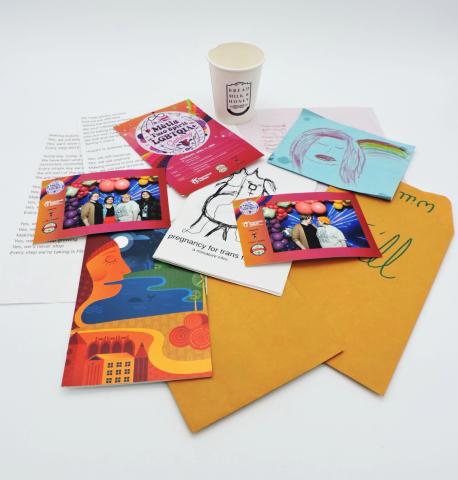
Since our meeting, Harper-Hugo Darling’s items have taken their place as part of RAM’s permanent collection. Most people imagine that the things we collect will head straight into an exhibit case, but there are several lives these items might live in the future. This collection, with its ample context straight from the mouth of its donor, allows us to respond to research requests from the community who want more information about queer or trans history in the province. Some pieces might be used in future programming like the objects our staff featured at Queer History Month events across the city last fall . The most obvious use, of course, is that taking in this donation has already enabled the writing of this blog post and allowed us to spotlight some of the stories, relationships, and everyday moments that might otherwise have gone unrecorded. In bringing these materials into the collection, we’re preserving context, memory, and lived experience, ensuring that these histories become pieces of the larger patchwork of Alberta’s past.
**
Our call for donations of queer history artifacts is ongoing. If you have items you think might tell a story about queer life in Alberta, please reach out! Whether you lived through key moments in Alberta’s queer history or simply lived your truth, we’d love to hear from you. While we’ve begun the work to address these gaps in our collection, we continue to search for stories that represent the vast spectrum of 2SLGBTQIA+ experiences, historical and contemporary, in this province. We hope that all Albertans can see themselves reflected in their provincial collection, and have the opportunity to learn more about our shared past.
**
Donations like Harper-Hugo Darling’s serve as a reminder that history is not always a newspaper headline or government document; it might be a thank you card you tucked away, a cup from a well-loved café, a doodle from a friend, or a story you’ve carried and shared with friends. Bringing these memories into the museum is one way we can honour that history and make space for a truthful, respectful, and inclusive understanding of the past.
Trans Day of Visibility might only be one calendar day a year, but the work of visibility and memory keeping continues year-round. As we continue to build this collection at RAM, in partnership with the 2SLGBTQIA+ communities it represents, we do so with the understanding that every story shared helps preserve the complexity and abundance of their heritage in this province.