The Pronghorn of the Prairies
By Nick Carter, Marketing and Communications Volunteer
Out on the open, rolling grasslands of southeastern Alberta, where the dry prairie air shimmers in the summer heat as Ferruginous Hawks circle in the big blue sky above and insects buzz from the brown grass, the pronghorn makes its home.
The pronghorn is a classic species of western North America. It lived in herds ranging from Alberta and Saskatchewan down to northern Mexico and the Baja Peninsula, favouring open prairies, scrubland, and deserts. Although in Alberta they’re largely confined to the southeastern grassland, pronghorn will wander widely in search of grazing areas, and have occasionally been reported as far west as the Calgary area and north up to southern Edmonton.
These four-legged, even-toed ungulates are slightly smaller than our native white-tailed and mule deer. They’re faster, though- the fastest land animal in North America, in fact. Aided by a wide windpipe, high haemoglobin count, and large heart, pronghorn can reach speeds of up to 90 km per hour for short periods of time. To prevent overheating while barreling across the scorching plains at such speeds, pronghorn have countercurrent heat exchangers in their necks to cool the incoming blood before it enters and cooks the brain.

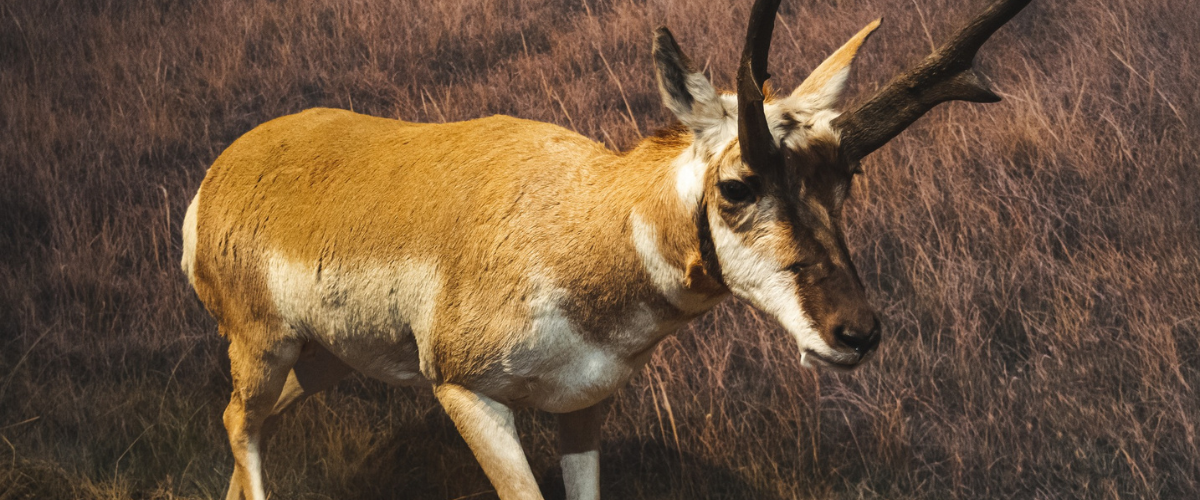
Pronghorn are a distinctive-looking animal. While vaguely deerlike at the distance, a closeup look shows how unique they are. They have long skinny legs, a deep chest, large pointed ears tipped with black, and big dark eyes. The upperparts are pale brown while the underside, flanks, and rump are white. Pronghorn also have white stripes on the throat, jaws, and forehead. Males have black patches on the upper throat and muzzle. True to their name, pronghorns are horned animals. These horns are tiny in females, but in males they’re noticeably bigger, curling inwards at the tips and with an upward prong at front, hence the name of the animal.
With this overall look and lifestyle spent running and grazing in herds across the grasslands, pronghorn are often compared to antelope, and are sometimes even referred to as ‘pronghorn antelope’ or ‘American antelope’. However, true antelope only live in Africa and Asia, and pronghorn aren’t one of them or even closely related to them. The resemblance is superficial, and comes from evolving comparable lifestyles. Pronghorn belong to an old and distinctly North American lineage of animals, the family Antilocapridae. The name means ‘antelope-goats’ but just as pronghorn aren’t antelope, neither are they goats.
The antilocaprids arose on this continent back in the early Miocene Epoch, part of the Neogene Period. Roughly 20 million years ago they split off from their sister group, the giraffe family, of all things. This was during a period of gradual cooling and drying in North America, when the ancient sub-tropical forests were giving way to open grasslands. During this time a variety of bizarre looking species arose in this family. Some had horns that almost look like deer antlers, while those of others looked like tightly-bound spirals that split at the tips. Antilocaprid diversity began to decline after the good old days of the Neogene until, following the end of the Ice Age, the modern pronghorn was all that was left.

The horns are another thing that make pronghorn distinct, and it’s not just their shape. True horns are composed of a bony inner core that grows from the top of the skull. This bony core is covered with a sheath of hard material called keratin, the same stuff that your hair and nails are made of, and that’s what you see on the outside of the horn. The keratin sheath stays in place and grows over the animal’s life. It’s what animals like cattle, antelope, and sheep have. This distinguishes horns from the antlers of deer, which, when they’ve finished growing and the nourishing velvet has come off, are just bare bone. Antlers often get shed each year following the breeding season, but in species like caribou in which all sexes have antlers it’s a bit more complicated. Pronghorn have the typical horn condition but unlike other horned animals, they shed the keratin sheath each year. In males this occurs in late fall after mating has occurred, while in females it’s more often in the summer, and a new sheath grows in place of the old one.
Prior to the European settlement of Alberta, pronghorn were extremely abundant here, as they were throughout the rest of western North America, with massive herds roaming the plains. Much like with bison, however, colonisation hit the pronghorn hard, and by the late 1910’s only about 3000 remained in Canada. Since then conservation efforts have helped pronghorn recover. Their range in Alberta is still not as extensive as it used to be, and pronghorn continue to be sensitive to extreme environmental conditions and the loss of native grassland habitat.
People can work together to give the pronghorn a hand, though. Helping to conserve Alberta’s native grassland and parkland areas gives these skittish animals a place to live, and reporting pronghorn sightings to citizen science websites like iNaturalist helps biologists learn more about their distribution. Ranchers in pronghorn country have also found a simple but effective way to help this species out. While pronghorn are amazing speedsters, they don’t jump well, and so the coming of fences to the prairies limited their movements. Pronghorn can, however, slip under wire fences with impressive skill while barely slowing their pace. As you can imagine, though, a large animal sliding under barbed wire at high speed is likely in for some nasty injuries. So, many ranchers have now begun stringing the bottom wire level of their fencelines with barbless wire, or even omitting the bottom wire altogether. This allows pronghorn to cross fences with much less risk of injury.
So the next time you’re driving through the open country of southern Alberta, keep an eye out for this survivor of a bygone era and imagine a time when the prairies were wild, and vast herds of pronghorn roamed across the endless ocean of grass.
Sources
Soper, J. Dewey. The Mammals of Alberta, The Hamly Press Ltd (1964). pp. 368-370.
Pattie, Donald L. and Fisher, Christopher C. Mammals of Alberta, Lone Pine Publishing (1999). pp. 38-40.
Naughton, Donna et al. The Natural History of Canadian Mammals, University of Toronto Press (2012). pp. 572-576.